

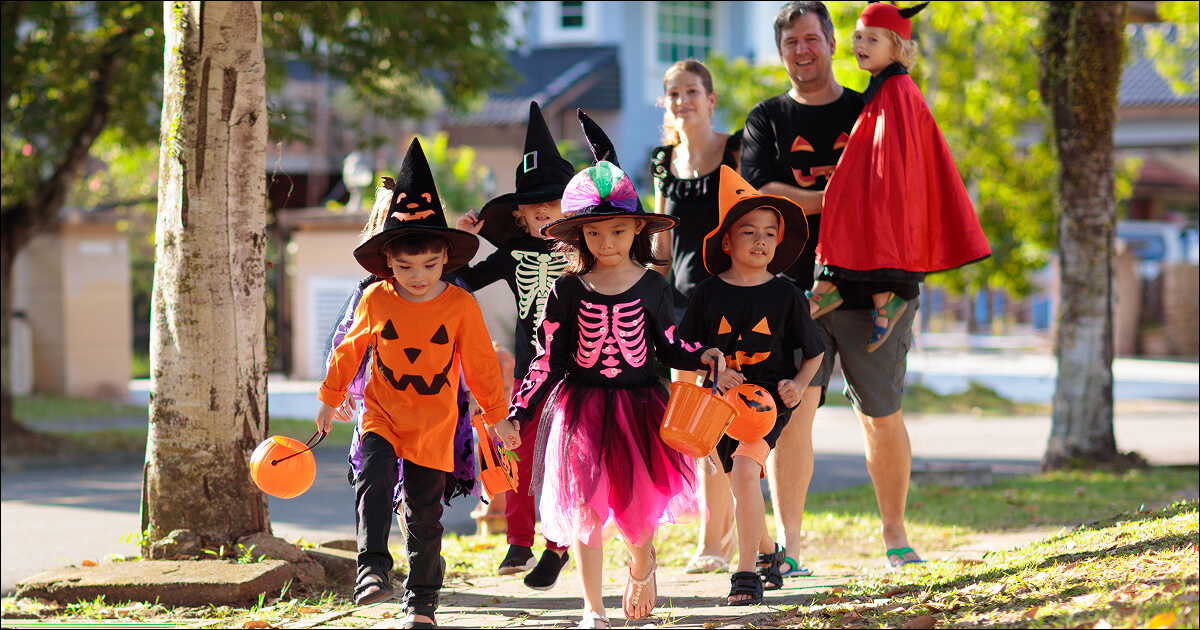
At around 5:30 in the evening on Halloween, the neighborhood changes. Porch lights flick on, small superheroes, fairies, and skeletons pour out of front doors, and sidewalks fill up with kids who are far more focused on the candy bowl two houses down than on the car turning the corner.
It’s one of the best nights of the year for families. It also happens to combine fading daylight, dark costumes, and a lot of excited children on residential streets where cars may be driving, pulling out of driveways, or looking for parking spots. Understanding the risks is the first step in keeping kids safe. Here are some things every parent should keep in mind as Halloween approaches.
Research Shows Pedestrian Fatality Risks Are Higher on Halloween
Researchers who examined 42 years of national crash data found that pedestrian deaths were 43% more likely on Halloween evenings than on comparable nights, which works out to roughly four additional deaths in an average year. Children between the ages of 4 and 8 stood out most: their risk was ten times higher on Halloween than on control nights.
In general, pedestrian deaths are rare. The same study that found these fatalities were more likely on Halloween also found that the overall rate of pedestrian deaths declined from 4.9 deaths per 100 million Americans between 1975 and 1985 to 2.5 deaths per 100 million Americans between 2006 and 2016.
Pennsylvania’s roads have been moving in the right direction too. PennDOT reported 1,047 traffic deaths statewide in 2025, the lowest since data recording began in 1928.
But Halloween night still shows up in the state’s crash data. PennDOT counted 358 crashes on Halloween 2024, with two fatalities and 231 injuries. Twenty-three of those crashes involved a pedestrian, and 20 involved impaired driving. The year before, 349 crashes were recorded, including four fatalities and 14 pedestrian-involved crashes.
Although these numbers are relatively low compared to the millions of Pennsylvanians who celebrate Halloween every year, the risk is still real. Recognizing the exact risks and planning ahead to counteract them is one of the simplest ways parents, teens, and drivers can ensure a safe and fun Halloween.
Risk One: Dusk
If there’s one stretch of the night worth paying attention to, it’s dusk. In a national study, researchers found that pedestrian deaths peaked around 6 p.m., right when trick-or-treating usually hits its stride. Drivers coming home from work are squinting into a gray, in-between kind of visibility, and kids in dark costumes can blend into the background.
Location matters, too. The researchers noted that most childhood pedestrian deaths occur in residential neighborhoods, which is exactly where trick-or-treating takes place. Add a few more hazards, like masks that narrow a child’s field of view, kids cutting between parked cars, and neighbors backing out of driveways, and you have a night where small, easily avoidable mistakes can quickly become extremely dangerous.
Risk Two: Visibility
Visibility, or the lack thereof, is another risk on Halloween night, one that goes hand-in-hand with driving at dusk. That adorable black cat costume or creepy mask can render your child or teen nearly invisible when darkness falls. Thankfully, this risk is one of the simplest to counteract.
PennDOT recommends that anyone in a dark costume add reflective tape, carry a flashlight, or wear clip-on LED lights or glow necklaces. Masks deserve a second look as well, because they can significantly limit a child or teenager’s field of vision. Face paint is often the better choice, as nothing gets in the way of seeing a car approach. It’s also important to make sure kids wear the proper footwear, not just for comfort but also to help reduce the risk of tripping and falling. Make sure your child’s shoes are comfortable, fit well, and won’t catch on long clothing or curbs.
Risk Three: Young Children
Any parent of a small child knows that even the most repeated of rules, things like “Don’t run” and “Stop at the corner,” can go out the window in the moment. Parents should always stay close to small children. Hold hands if your child is likely to take off and encourage older kids to follow the rules before leaving the house. Always cross at corners and crosswalks, look left, right, and left again before crossing, and encourage kids to walk, not run, along sidewalks and across streets (yes, you will probably have to repeat yourself).
The most important rule might be one parents haven’t necessarily thought of: never dart out from between parked cars. On Halloween, when houses are decked out with lights and lawn ornaments, kids are more likely to want to cross in the middle of the street, sometimes from behind parked cars. But drivers can’t see a child who appears out of nowhere. Always walk with your child to the corner and look both ways before crossing. Don’t assume a driver will stop just because they have a stop sign or red light; they may be distracted by trick-or-treaters, decorated houses, a cell phone, or something else and fail to see the stop.
It also helps to know how Pennsylvania’s driving and pedestrian rules work. Drivers must yield to pedestrians in a crosswalk, while a pedestrian crossing outside of one must yield to vehicles. Where there’s no sidewalk, PennDOT advises walking facing oncoming traffic so you can see what’s coming. For the youngest trick-or-treaters, an adult walking alongside the kids and crossing as a group is the simplest safeguard.
Keeping Preteens & Teenagers Safe on Halloween
Your 13- or 14-year-old may be aging out of trick-or-treating, but many kids around this age still enjoy celebrating the holiday in some fashion. A teen doesn’t need to hold your hand at the crosswalk, but that doesn’t mean they don’t face certain risks on Halloween night, although these risks look different at this age. Teenaged trick-or-treaters often go out in groups without a parent, they’re more likely to have earbuds in and a phone in hand, and the night may include a party after the candy has been collected.
Distraction is one of the biggest risks for trick-or-treating teens. It’s also a risk parents can address directly. Research from Safe Kids Worldwide found that half of the teens surveyed said they cross the street while distracted by a mobile device, and 40% reported having been hit or nearly hit by a vehicle while walking.
For parents, finding the balance between allowing teenagers some independence and keeping them safe can feel tricky, but it doesn’t have to be. Rather than lecturing, try framing it as a simple agreement: phones and headphones go away at crossings, and the group sticks together. Then settle the logistics, including where they’ll be, when they’ll check in, and who is giving them a ride home. Impaired driving was a factor in 20 of Pennsylvania’s Halloween crashes in 2024, so it’s important to make sure your child has a dependable plan for getting home safely.
If your teen has a driver’s license, this is a good moment to talk about the other side of the equation. PennDOT noted that fatalities in crashes involving 16- and 17-year-old drivers rose from 27 to 31 in 2025. A night full of pedestrians, many of them small children in dark-colored costumes, is a good time to remind new drivers to take it slow, stay off their phones, and drive cautiously, especially in residential areas.
Safety Tips If You’re the One Behind the Wheel on October 31
Plenty of people will be driving on Halloween evening, whether they’re picking up kids, getting home from work, or heading to a gathering. If you plan to drive on Halloween, be extra careful. In neighborhoods with trick-or-treaters, keep your speed down, turn your headlights on early, and scan curbs and driveways, as well as the road ahead. Kids on Halloween are small, hard to see, excited, and unpredictable, and they may cross in places a driver wouldn’t expect.
Pennsylvania’s hands-free law is also in the picture here. PennDOT credits this law with helping push distracted-driving deaths down over the long term, and keeping your phone out of your hand is one of the simplest ways to avoid a car accident at any time of year but especially on a night when the sidewalks are full of trick-or-treaters and their parents. It’s important to know that even a hands-free call, while legal, can be distracting. Stay vigilant to keep yourself and others safe.
Stay Safe & Have a Happy Halloween
Trick-or-treating doesn’t need to change a ton to be a safe and fun night for all. Adding a reflective strip to your child’s costume, reviewing the rules before you head out, and a well-communicated plan for teens go a long way. With just a few easy safety measures, the rest of the evening can be about costumes and candy.
If your family does experience a pedestrian accident, or has lost a loved one in a crash and is weighing a wrongful death claim, the attorneys at Handler, Henning & Rosenberg are available to talk through your options.